
The Community Bicycle Network started these last night, but theygo for the next 3 Wednesdays as well.
- Flat-fix / Basic Tune-up Workshop - Feb. 13, 7-10 pm
- Wheel Building Workshop A - Feb. 20, 7-10 pm
- Wheel Building Workshop B - Feb. 27, 7-10 pm
More information on the CBN website.Email us as soon as possible to register for one of the dates listed above, or contact us immediately if your plans have changed so that we might fill the spot.
Price: $30 per person per class. Registration is required with a cash deposit of $10 at our office, 761 Queen St. West between 2-6pm Monday to Friday. A maximum of 6 people per class will be accepted.
The class location is: CBN Intersection, 761 Queen Street West, Toronto.
It may be the middle of winter, but as TreeHugger points out, now is a great time to start planning your summer bike trips - if you're the type of person who likes "touring".
TreeHugger Andrew goes through all the basics, from where to stay (everything from camping to hotels), what you need on your bike (good tires, good gears, good seat, etc) to how to pick where you are going:
Next, you want to pick a route. The Adventure Cycling Association puts out fantastic maps for numerous routes around the country. I selected the TransAmerica Trail, but chances are, they have a map for the route you want to do. The great thing about their maps is that they are waterproof; designed specifically for cyclists; provide turn-by-turn directions; and show where gas stations, campgrounds and other essential services can be found along the route. Even if you select your own route and maps, Adventure Cycling is a great starting point, and offers lots of other great information. Also, all their map sets explain the ideal time of year to start a particular route. Another great source of information is KenKifer.com; there you can learn more about bicycle touring, commuting, culture and humor.For those of us not biking in the States this summer, the Cycle Ontario Alliance Bicycling Route Page is an okay place to start doing research on nice places to ride in Ontario.
Canadatrails.ca looks like a good national resource, but if you know of others, please leave a comment to let other BikingToronto readers know.
[Photo by dentarthurdent]
Labels: how-to
 In case anyone doesn't know about it yet, the City of Toronto is running a "Bike Winter" from December 1st to March 1st to encourage winter cycling in our great city.
They've posted a handy-dandy brochure (PDF) to help those new to winter cycling get into it, with handy tips and often humourous "things to watch for":
Watch for: The new relationship you may develop with your hot shower and clothes dryer. Getting chilly will help you appreciate the following warmth.
They've posted a lot of good tips in non-PDF form too!
- Keeping warm and dry
- Riding tips
- Visibility
- Bicycle choice and equipment
- Maintenance
- Wet weather
- Snow and ice
 Are you a member of the fairer sex who is already a pro at basic bike repair like fixing flats and adjusting your breaks? You'll want to check out a new series of Advanced Course from the lovely ladies of the Community Bicycle Network:
Wenches with Wrenches is an ongoing program of CBN volunteers who host bicycle repair workshops run by and for women in downtown Toronto. It brings women together in a safe, non-competitive and friendly learning environment. The workshops are run by women for women because, many times, women are just more comfortable learning from other women.
The Advanced Course Schedule:
Saturday, November 3, 2007. 3:00 pm to 5:30 pm.
Ball Bearings: For those who have already taken the Wenches with Wrenches classes and want a little more, or for those with a little bike repair experience already under their belt, here is a chance to learn about the bearings systems in your bike: everything that pivots has one of these! Everyone will have an opportunity to repack ONE bearings system on their bike during the class (i.e. one hub, a bottom bracket, or a headset).
Cost: $15
Sunday, November 11, 2007. 1:00 pm to 3:30 pm.
Wheel Truing: Why does your wheel wobble? Why do your brakes rub, but only occasionally? What do you do when a spoke breaks? We will learn the basics of wheel truing: when (and when not) to adjust the tension on your spokes; how to bring a wheel back to true, and when it's not worth it; what to do with an emergency wheel true situation. Bring wheels, bring questions, and badly out-of-true wheels will be provided for practice!
Cost: $15
Registration
Registration required in advance, at Urbane Cyclist, 180 John St. (just north of Queen St. and CityTV). CASH ONLY at registration! Register for both classes at the same time and pay only $25 for both!
[my apologies for the home-reno graphic - it's too good not to use. :) - Joe ]
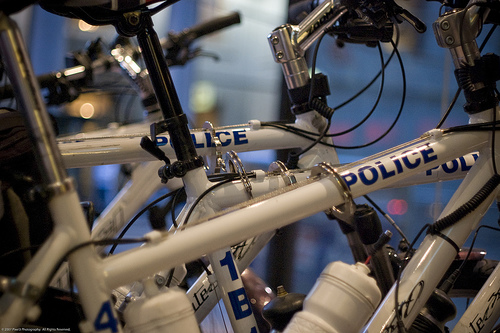
The Toronto Police Service has recently announced that gone are the days of printing out and filling out hardcopy forms to register your beloved bike with them (although you can still do that [pdf file] if that floats your boat... er, greases your chain...)
Yup, you can now register your bike with the TPS online :
Bike owners can add themselves to 50,000 bicycles already registered by clicking on the bicycle icon on the TPS internet home page (torontopolice.on.ca) and filling out the registration form online.
“It’s a simpler, refined and easier process for members of the community to register their bicycles,” said Property and Evidence Management Unit supervisor Brenda Radix. “They can use the system 24 hours a day, seven days a week and it’s free of charge.”
The serial numbers will be added to the database so police can return the over-900 bicycles recovered or turned over to police each year. Less than 5% of those bikes are returned to their rightful owners because no serial number has been registered. Those bikes not claimed are sold by online auction.
[photo credit]
Flat fix and tune-up course @ CBN
7:00pm- 9:00pm
 The Community Bicycle Network introduces mechanic classes for beginners. The classes are taught by experienced mechanics and provide an intimate, focused, learning environment. Learning some basics about your bike saves you money in the long run when you can change your own tube or adjust your brakes.
Dates: Wednesday evenings from 7pm until 9pm, weekly, beginning August 15th
Cost: $30 (including any deposit)
- Bring your own Bike (encouraged but not absolutely necessary)
- Two hour class.
- Maximum 6 people per class.
- Minimum 3.
Please RSVP by sending an email to [email protected] with the subject "Bike Mechanic Class RSVP", or by phoning 416-504-2918 and leaving a message under "general inquiries" stating that you wish to RSVP for the Bike Mechanic Class with your name and number. Someone will return your email or call to confirm how to RSVP a spot (and how to pay a deposit). Those who provide a $10 non-refundable deposit will be given preference on the list.
The class consists of:
Flat Fix - hands-on segment:
- Participants will remove their own rear wheel and tire and go through a tube repair and installation.
A brief discussion of:
- Bike fit
- General safety issues (loose parts, damage, etc)
- Lubrication
Brakes - instructor demo/description:
- general concepts and adjustment
- safety!
Gears and drive train - instructor demo/description:
- general concepts and adjustment
It's Olivia Chow. The left-leaning federal politician (formerly of Toronto City Council) is a renowned bike-lover, and is often seen toolin' around on a tandem bike she shares with her hubby, Federal NDP leader Jack Layton (also formerly of Toronto City Council).
Here's a good video of Olivia and safety tips for biking Toronto. :)
The wenches are back!
View all the details on the Community Bicycle Network website, including dates, times and topics!
2007 Season Ready to Roll!Wenches with Wrenches is an ongoing program of CBN volunteers who host bicycle repair workshops run by and for women in downtown Toronto. The idea has been to make basic bicycle repair skills accessible to women in the hope that participants will then share their knowledge and their confidence with others in the community
Wenches with Wrenches brings women together in a safe, non-competitive and friendly learning environment. The workshops are run by women for women because, many times, women are just more comfortable learning from other women.
Wenches With Wrenches are always looking for more people to join our group! You don't need any mechanical experience to become a Wench; just a smile and a readiness to help out and learn.
AND, they even have a Wench Mailing List!
Wench it up!
I meant to post this yesterday, since it absolutely poured yesterday morning, and I was wondering how many people accepted the challenge from Mother Nature.
Yeah, I look at extreme weather (well, extreme for Toronto...) as short, doable challenges to tackle on my 7 km commute to work. The main challenge is being prepared enough to still have a good day at work. Oh, and having something good and witty to say to co-workers who think you're nuts for biking in the rain (like you'll melt or something. haha.)
I kind of wish I had my camera with me when I was going through Riverdale and the heavens opened up and emptied what seemed lik gallons of water on me.
As Tuco recently said, riding in the rain is actually not bad (I secretly love it, even cold rains in the fall and spring, because it makes me feel alive), it's the post-ride stuff you do and are prepared for.
Here's what I do on the days I wake up and the world is wet:
1. Dress appropriate to the temperature. Rain usually doesn't make the air a lot colder, and if you put too much on, it's more stuff that will be soggy later.
2. Take extra clothes. I'm lucky that my work provides little closets next to everyone's desk in our cubefarms, so I leave my dress clothes at work (dry cleaning them regularly) and can therefore bike in normal clothes - On normal days I take extra underwear and socks and a t-shirt. On rainy days, I take two sets of this stuff and stick it in grocery bags, in one pannier bag.
3. Dry feet are important. Like Lieutenant Dan says in Forrest Gump, take care of your feet, Gump! I stick my shoes in another grocery bag, and put that in the other pannier bag. I then wear OLD shoes when I bike in the rain. This may sound weird, but it means that when you're ready to bike home in the afternoon (when it most likely won't be raining), your nice biking shoes are dry. I keep my dress shoes at work like I do my dress clothes.
4. Stinky people aren't popular. You need to prepare to not stink at work. Biking in the rain makes you very wet. Wet human smells almost as bad as wet dog, especially in an office environment. If you are one of the lucky few who have a shower at work, use it. If not, pack a towel in one of your pannier bags. It'll help you dry out when you change in the bathroom. Also, keep deoderant and a small thing of cologne/perfume (don't use too much!) in a desk drawer that you can use to de-stank-ify yourself.
Darren J also has a wildly popular post with great advice called How To Always Smell Fresh (Even When Your Workplace Has No Shower).
That's about it. It's what I've learned about biking in the rain so far.
With a bit of preparation, you can tackle the wet streets at a bit slower pace (your brakes and car brakes won't work as well in the rain), and enjoy all that liquid sunshine reminding you that taking shelter in cars is for people weaker than you.
Labels: how-to
 As promised, here's all 8 Secrets in one post (I have them linked individually down at the bottom, if that's what floats your boat...). This is the easiest way to print out all of them into a poster you can hang in your bedroom, cubicle and on your grocery store bulletin board. Haha.
One secret I didn't include is the most important one:
While these 8 things will help you deal with car traffic in a city, you'll learn them with experience, so the most important thing you can do to make yourself comfortable on the roads is to bike a lot. You'll become more and more comfortable the more experience you have out there.
 For instance, I have a 7 km route to work, and I know through lots of repetition of this route where cars tend to slow down and speed up... where I have to be extra-vigilent and careful due to drivers thinking they can pass me safely when they can't. This isn't learned through 8 tips on a website, but with experience.
 These tips though, these tips will help you become more comfortable faster, as you have now essentially pulled out all the information I've learned over the past 2 years biking Toronto.
~ ~ ~ ~ ~
These are geared towards downtown cycling, since that's what I'm most familiar with.
These all assume that you already know about proper lighting and safety (ie. helmets) precautions, and know that riding on sidewalks is one of the most unsafe things you can do, for both pedestrians and yourself.
~ ~ ~ ~ ~
1. Drivers Don't Want to Kill You
 It's hard to believe sometimes, because drivers can often do some pretty thoughtless things out there, and despite all the evidence to the contrary, it's true.
 They may not like you... they may think you are in their way, that you are too slow, that you don't belong on the road, and that your tight cycling butt looks way better than their flabby one stuck in their car, but most of them are not homicidal.
This is mainly because they are seeing things from a drivers' perspective, and often have not given much thought to how vulnerable cyclists are. The vast majority of drivers don't want to kill you... they just don't understand you.
I bet any cyclist you know with a drivers license can tell you that knowing things from a cyclists' perspective has made them a much better driver.
Knowing this one thing will give you a lot of confidence.
2. Ride In A Straight Line
 Don't ride in the gutters and then swing out into the road to avoid the drains. This throws drivers off-guard because they aren't thinking about the drains and aren't expecting you to do this. There's a very good chance you'll get honked at if you do this, because nothing scares a driver more than a cyclist swerving in front of their car.
 Instead, imagine that the entire length of the road is lined with gutters. Ride at least that far away from the curb. It's hard at first, because you may be afraid of those cars driving beside you, but most drivers will pass you at a safe distance the further you ride out from the curb.
3. Play By The Rules
 You and your bike constitute "a vehicle" according to the Highway Traffic Act. This means that you have to abide to the same rules that drivers do. This means stopping at red lights, stopping for people at crosswalks, and not passing open streetcar doors.
 This is really important because if drivers see you respecting the laws, they are more likely to respect you. On the other hand, if they're stopped at a red light and you blow right through it because (hopefully) the way is clear, they are going to be mad at you.
Why should they treat you like a vehicle with a right to the road if you don't behave like one?
4. Avoid The "Stoplight Squeeze"
 The next time you get to a red light before cars do, DON'T put your right foot down on the curb. I know it's tempting as it's a handy little footrest, but if you're right beside the curb, any drivers that come up behind you will drive up beside you (often too close) and you'll be "squeezed" when the light turns green, having to wait for that car to go before you can.
 Instead, when you get to the red before cars, swing out a little to the left (I usually stop about 1/3 of the way between the curb and the next lane), and lean over to the left, putting your left foot down. This forces drivers to stop behind you, and gives you "first dibs" when the light turns green.
5. Signal Sensibly
 Drivers are trained to look for signals. Stoplights, stop signs, turn signals, brake lights... all of these things catch the attention of a driver. It's what they look for to make sure they don't hit anyone. Letting them know that you're planning on turning, or coming out into the road more to pass a parked car is just courteous (see #3 above).
 Biking hand-signals are traditionally confusing... pointing up means turning right? Pointing left means you're going straight? That's confusing - especially for drivers who don't know about cycling.
Apparently, it's now acceptable to point in the direction you're going (it makes sense), so point where you're going. It keeps everyone on the same page. Do it well ahead of any turns, so that drivers know that you're planning to turn, and they can act accordingly to avoid you.
6. Take That Lane
 This is just what it sounds like. Taking your place in the middle of a lane because it's unsafe at the edge of it.
 This is mostly done on streets where the curb lane is filled with parked cars. You can't ride in the curb lane right beside the cars because of the possibility of getting "doored" (also called "winning the door-prize") by someone getting out of their car.
Therefore, you ride in the other lane. Most of the time (especially downtown), you'll be moving at the same speed (or faster) than vehicular traffic, so you'll fit right in to traffic.
If you're moving slower than traffic, remember that you're a vehicle and have a right to be there if you're abiding by the laws, and move out of the lane whenever you get a chance.
7. Make Them Think You're Unpredictable
 This is something that I've learned only recently. If I'm in a stretch of road where drivers are passing too closely or I just want more room, I look over to my left or over my left shoulder. Sometimes I'll be looking at a store, or someone on the sidewalk, or down a street, but most of the time I'm just looking left for the sake of looking left.
 I've found that the simple act of looking over to the left is enough sometimes to give me more road space. Drivers, if they see you do this, seem to think that you're thinking of moving to the left (even if you aren't) and are checking to see if it's clear.
If they think you may be coming left, they'll give you more room. They don't know you're responsible and predictable and would signal before doing anything.
8. Ride With Others
 I don't get a chance to do this often (especially lately because it's been winter) but the biggest factor when riding with cars is having a presence. It's easiest to do this if there is more than just you biking.
 Cars are more likely to see 2 bikes than one, 4 bikes than 2, 10 bikes than 4, and so on. The more bikes, the more chances that one of the people riding them will do something unpredictable, so drivers give groups of bikes (even those riding single-file) much more space than single riders.
You don't have to know everyone you're riding with either... when the weather is warm, there are lots of bikes out on the street, and often you'll find yourself riding with other people out there on the road. Notice that you'll hardly ever have a close call with a car passing you too closely if there's atleast 2 of you riding along. Not to say it never happens... it just seems to happen less.
 The main thing to do is get out on your bike as much as you can... the more people see you out there having a good time, going faster than traffic in a fun, cheap, and pollution-free way, the more likely they are to try it too. The numbers of cyclists on the road has the potential to grow exponentially this way.... the more cyclists people see out there, the more people are curious to try it. Imagine if you saw groups of cyclists riding by you all day every day... you'd want to know what all the fuss was about!
This is also the concept behind Critical Mass and the Ride Matching (or BikePooling) section of the Cycling Cog... it's easy for a driver in a car to bully one cyclist off the road, but stick a few (or more) cyclists on the road, and they take on the presence of a car... perhaps more than one car. There is strength in numbers.
Note: Thanks to everyone who has left comments in this series of posts, and to everyone who has linked to them. I'm happy that you are finding them useful. I'll be putting all of them into one post sometime tomorrow for easy reference, feel free to tell anyone you know who is new to biking (or is thinking of taking it up) about them.
Individual Secrets:
1. Drivers Don't Want to Kill You
2. Ride In A Straight Line
3. Play By The Rules
4. Avoid The "Stoplight Squeeze"
5. Signal Sensibly
6. Take That Lane
7. Make Them Think You're Unpredictable
8. Ride With Others