
This will be in the news forever.
Today, it's a Globe & Mail news item about mandatory helmet use by all cyclists.
What these articles NEVER mention is that in accidents involving car occupants and/or pedestrians, the injured are NEVER wearing helmets. If it's much more likely that someone will be hurt while in a car or as a pedestrian, shouldn't helmets be mandatory for them?
I've posted about this before, using official statistics from the Canadian Institute for Health Information, but if you don't feel like reading my earlier post, here's the most important bits:
I find it interesting that only about 10% (~500 out of ~5000) of traumatic head injuries suffered by children happened while cycling - yet helmets are mandatory for them. 90% of child traumatic head injuries did NOT happen while cycling.
only about 2.5% (~300 out of ~12,000) of traumatic head injuries suffered by adults happened while cycling. 97.5% of traumatic head injuries did NOT happen while cycling. In fact, most of them happened in motor vehicle accidents.
I used to wear a helmet. Now I don't.
Wearing a helmet does not determine whether I get hit by a car or not. Whether I get hit or not depends on the driver, and that I ride my bike in a safe manner (which I do).
It's a given that if I suffer a head injury, it will be less serious if I am wearing a helmet. However, given that according to the CIHI, only about 300 adults are hospitalized per year with cycling-related head injuries... the chances of me being hit and suffering a head-related injury that a helmet could mitigate is very small.
Of 2500 Major Head Injuries Annually in Ontario
49% motor vehicle involvement - including pedestrians, excluding cyclists
35% falls, 6% homicide, 2% suicide, 6% other causes
less than 2% Cycling
(Source: Canadian Institute For Health Information 2001/2002) [link]
I base my behaviour on the statistics. Not the hysteria.
Also, and this is a biggie... biking is a lot more fun without a helmet. Try it on some quiet sidestreets and you'll thank me.
Good links:
- None of us wear helmets while walking or riding in cars*. Is there any good reason to wear them on bicycles?
- Crash helmets are associated with dangerous activities. Is cycling dangerous?
[source]
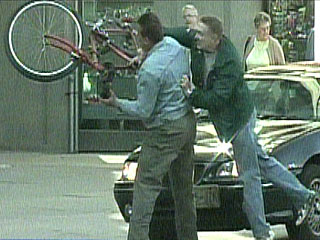
Yes, the driver in the road rage incident yesterday (the one in which a driver lost his bananas on a cyclist who didn't bike through a yellow light) is a policeman. A suspended policeman.
I'm tempted to give some "props" to the cop for turning himself in... but wonder if he would've if a video camera didn't catch the whole thing? Let's be positive and assume he would have.
Interesting coverage (and subsequent coverage) in the Toronto blogs today too:
Spacing Wire - comments are generally supportive of the cyclist, with some discussing ways to discourage automobile use on smog days.
BlogTO - comments are mixed ... some are saying that the cyclist wanted to throw his bike on the hood of the car (which somehow justifies the behaviour of the driver?)
The cyclist does pick up his bike, but seeing as how it's AFTER the driver has already kicked it, I think the cyclist was just trying to get the bike out of harms way. Add this to the fact that the cyclist was trying to get away from the psycho driver hitting him... well, it doesn't seem like the cyclist is that confrontational.
Now, having made that argument... if a driver kicked or hit your bike with the intention of damaging it... why is intending to damage their car viewed as worse? Because the driver spent more money on their vehicle? That's their mistake.
(Cross-posted to I Bike T.O.)
-
 said...
-
BlogTO and Torontoist readers are a weird, mix bag. I think too many of them are sniffing markers.
-
 Tuco said...
-
My jaw dropped open last night when I saw on the news that this guy was a cop! I haven't read far enough to figure out what he was suspended, but you wonder if it was something to do with chronic rage?
So the cops won't ticket cars parked in bike lanes, but they will slug cyclists who stop at yellow lights - awesome. -
Andrew said...
-
I think things could have been much worse. For example, the driver/cop could have used their car instead of their fist to enforce their version of justice.
"It was supposed to be a class project on public spaces in Toronto. But it turned into an amazing education on the legal system for a group of Grade 12 students Tuesday. Their cameras were rolling when they caught a startling crime on tape - a road rage incident in which a man physically attacks a cyclist."
More on CityNews
-
said...
-
f*cking typical that the cop did'nt belive it till the video they never believe any thing between a car or car driver and I bett the driver will get alittle tap on the wrist like normal
-
Tuco said...
-
Just after the motorist kicked the guy's bike, I'd like to know what the cyclist was going to do - or said he was going to do - as he picked his bike up and seemed about to toss it onto the hood of the car or into the windshield.
As inclined as I am to be sympathetic to the cyclist - the threat of having a bike thrown at his windshield may have been what really set the motorist off.
Marc Lostracco of Torontoist asks a great question: 9 years after the Coroner's report recommending sideguards for trucks for cyclist and pedestrain safety, why won't Transport Canada set requirements in the Highway Traffic Act that all new trucks be designed with side wheel guards to deflect cyclists in a collision?
In the U.K. and Europe, the deflectors have been mandated by law since the 1980s. According to the City staff report, Transport Canada advised that there is currently "no similar Canadian regulation because the nature of the traffic mix in Canada is different to that in Europe." So? With few bike lanes and so many construction and utility vehicles, Toronto cyclists are at particular risk at a rate of about ten injurious collisions with large trucks annually.
Tons more great info and links at Torontoist.
(Cross-posted to I Bike T.O.)Labels: safety
While my regular commute doesn't take me on a lot of bikelanes, I have started carrying a camera most days, so when I saw 3 trucks parked in the bikelane on the north side of College between Bay & Elizabeth (a 100 metre stretch), I started snapping, and I just posted them to the Toronto MyBikeLane site:
Purolator
Canada Post (which pulled right up behind the Purolater Truck as I was taking photos)
Fed Ex
More info about MyBikeLane, from the site:
MyBikelane is built on the notion that:
- Cyclists are sick of having to dodge cars and trucks using the bikelane illegally.
- These illegally parked cars force cyclists into traffic, making their commute more dangerous.
- Those cyclists have cameras or cell phones w/ cameras.
- Using the power of the community, we can hopefully make the problem more obvious and get the city to do something about it.
- This makes it safer to cycle for fun or to commute.
How MyBikelane works:
- You the cyclist see a car parked illegally.
- You snap a picture, taking care to capture the license plate of the vehicle and proof that the vehicle is parked illegally.
- You upload the photo, tell us when and where the incident occurred and the license plate info.
- We make the site available to media, city officials, and the web to show the problem.
Labels: infrastructure, safety
I also bought a new bike helmet a while ago, because my old one was showing it's age (I bought it in 1998) but had been in good condition since I always treated it well and never had the occasion to need it (no falls on my head). The shell had begun to crack a little, so I figured it was time to get a new one.
Now, anyone who knows me (or has had occasion to hat shop with me) knows that I have an enormous head. Like, freakishly big, almost... okay... maybe not THAT big... but regular hats and helmets don't fit my noggin.
I eventually found a nice looking helmet that just fit me... but this morning I found out that when I'm wearing my very-cold-weather headgear (balaclava and wool hat), this new helmet does not fit.
So, I biked to work helmetless for the first time. I take a lot of sidestreets in the winter, as it's quieter and more peaceful, with less fighting with cars, and no slush and crap being sprayed by tires.
Not like helmets make a lot of difference anyways. Someone my age is over 20x more likely to suffer a head injury requiring hospitalization from being in a car during an accident than riding a bike.
Anyhow... I just went on a coffee run over to Tim Horton's, and it's BEAUTIFUL outside. While the WeatherNetwork is saying it's -8C (-18C with windchill), it feels warmer... maybe just below O... the ride home tonight is going to be great.
3 comment(s) on this post
links to this post


-
Vic said...
-
Yeah! It's awesome out there.
I missed riding on the first 3 days of the week, but rode today. I had a dentist appointment in the morning, so my ride to work was after rush hour. Definitely noticed the lack of cars, even on the main streets that I normally ride.
I'm tempted to take the "long way" home tonight just for the hell of it. -
Joe (BikingToronto) said...
-
Yeah, while I took sidestreets along the Danforth, I rode Yonge from Bloor to College because it was empty...very weird for 8 am in the morning.
I had a huge lunch, so I'm considering a long way home too.... I probably won't need dinner either. :) -
Vic said...
-
I ended up riding about 54km yesterday. 31 of that was after work - basically Square One to St. Clair and Yonge. That was the easy part with the tail wind...I was flying. Coming back to Etobicoke was was a bit more of a struggle into the cold wind. I was frozen by the time I got home....and very hungry.... I hardly had my shoes off before my head was stuck in the fridge.
I have also decided that I really like riding on St. Clair because of the rolling hills. Pavement sucks though.
Links to this post:
Akin to the whole "cyclists should wear helmets, to avoid a brain injury caused by a direct hit to the head" thing, because a few stupid kids (and we're all stupid as kids, aren't we?) get hurt, let's slap helmets on everyone.
Is full-body armour next? I'm surprised "safety experts" aren't mandating that for cyclists already.
Anyhow - to avoid this post being full of just my incensed rage at a society that thinks that helmets will prevent dumb accidents on a toboggan hill (or on a bike), I went out and found some hard numbers for you:
This is from the Canadian Institute for Health Information - a very reputable source.
Traumatic head injuries were sustained during sports and recreational activities in 28% of children and youth admitted to hospital for traumatic injury, and 8% of adults. Cycling is one of the leading causes of sports and recreation–related head injury. Of the 4,605 cycling injury hospitalizations in 2003–2004, 18% were due to head injuries. The highest proportion of hospitalizations due to cycling-related head injuries was seen in children and youth (60%).Let's look at what is implied, but not said in the above paragraph:
- Traumatic head injuries were NOT sustained during sports and recreational activities in 72% of children and 92% of adults.
- Of 4,605 cycling injury hospitalizations in 2003-2004, 82% were NOT due to head injuries.
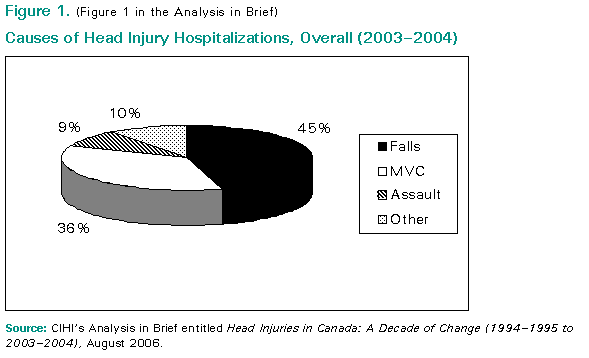
Among Canadians between 20 and 39 years of age, more than half of traumatic head injuries were due to motor vehicle incidents in 2003–2004 (1,867 admissions), followed by assault and homicide, which accounted for one-fifth of cases for this age group, or 722 admissions. For Canadians between the ages of 40 and 59, motor vehicles also accounted for the largest proportion of traumatic head injuries (40% or 1,308 admissions), followed closely by falls (39% or 1,290 admissions).The CIHI site also has some good tables and charts about this issue.
I find it interesting that only about 10% (~500 out of ~5000) of traumatic head injuries suffered by children happened while cycling - yet helmets are mandatory for them. 90% of child traumatic head injuries did NOT happen while cycling! What about the 90% of the time they aren't on their bike and their heads get hurt? Shouldn't they be wearing helmets then too?
There are some provincial politicians who think that helmets should be mandatory for adult cyclists too, yet only about 2.5% (~300 out of ~12,000) of traumatic head injuries suffered by adults happened while cycling. 97.5% of traumatic head injuries did NOT happen while cycling. In fact, most of them happened in motor vehicle accidents.
Why don't people in cars wear helmets? They are MUCH more likely to hurt their heads in a car than on a bike.
Combat the hysteria with common sense and cold hard facts.
Labels: safety
5 comment(s) on this post
links to this post
-
argonic said...
-
I think I'm just going to get a helmet and wear it all the time. Except maybe in bed; I think I'm safe there.
-
Joe (BikingToronto) said...
-
Sleeping is more exciting without a helmet. :)
-
bz said...
-
if you can reduce traumatic brain injuries by 18%, you have made a significant impact (no pun intended) to public health. 18% is huge.
-
Andy said...
-
Statistics are such tricky things.
I'm no expert, but it seems clear to me that even if only 18% of cycling injuries are head injuries, a broken skull isn't equal to a broken leg. I consider my head to be more important. (And perhaps that figure was only 18% because some people were wearing helmets.)
The fact that the older you get, the more likely you are to be injured in a car than on a bike isn't surprising either. The proportion of adults riding bikes is much smaller than the proportion of kids riding bikes -- almost all kids ride bikes, and most adults don't on any regular basis. Not to mention that kids tend to experiment and risk a bit more -- I haven't jumped many ramps since high school.
Just because kids injure their heads falling down stairs doesn't mean they shouldn't wear helmets on bikes. It means you should put a gate across the top of the stairs when they're young. How to make cars safer is a whole other topic. -
Joe (BikingToronto) said...
-
I'm sure that most of the car head injuries are on highways too... where most average speeds are 120-140 kph. - You can wear anything and your brains are still gravy if you're in an accident.
Links to this post:
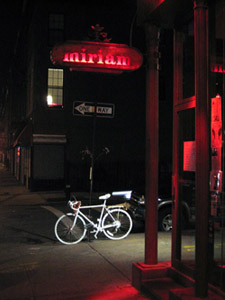 Whenever a cyclist is killed on Toronto's streets, the cycling community bands together to remember them with a memorial ride and sometimes a ghostbike installation to bring attention to the fact that cyclists are vulnerable road users, and that all road users (but especially car drivers) should always be careful.
NYC's Streetsblog asks "Memorializing Killed Cyclists: Is it Good For Cycling?", pointing out that sometimes memorial rides and ghostbikes actually scare people away from cycling:
With a new year having just arrived, perhaps it is a good moment for bicycling advocates to take a step back and ask what our goals are and whether heavily publicized memorial rides and prominent Ghost Bikes are helping to achieve those goals. Is there a way to advocate for bike safety improvements and acknowledge cyclists' deaths and injuries without sending the message to potential new cyclists that New York City is too dangerous to try biking?Fortunately, another Streetsblog post lists all the good points of memorial rides and ghostbikes. Here's a partial list for you:
- The Ghost Bikes memorialize people who deserve to be remembered for their bravery, both physical and cultural.
- They are an antidote to the sad, ordinary fate of deaths by automobile -- to "flicker briefly across the city's consciousness and then flutter away, leaving in their wake only grieving families and friends."
- The Ghost Bikes and Memorial Ride create an opportunity for victims' families and friends to engage publicly and politically.
- The Memorial Ride promotes cyclist solidarity.
Personally, I find them bittersweet. It feels good remembering a fellow cyclist who was out there trying to make our city a more livable place with cleaner air and safer streets... but it feels awful knowing that they died doing this.
What's your opinion?
0 comment(s) on this post
links to this post
Cyclists are always aware of being almost killed all the time because a driver speeds right by them with inches to spare, all in an effort to save 2 seconds driving to work.
Drivers can do this because they are the bullies of the public roads. In a conflict with a pedestrian or cyclist, they always win.
The recent increase in pedestrian fatalities is all over the news, with reports that pedestrians are now being hit in signalled, lighted crosswalks. I saw this on the news this morning, but of course the "hosts" of a show like Breakfast Television encouraged pedestrians to be careful... not just drivers.
What the hell?
If someone can't cross the street at a lighted, signalled crosswalk, WITHOUT fearing for their life, there is something VERY wrong with this city. ESPECIALLY when the "news outlets" (fearmongers) admonish pedestrians for thinking that they, taxpayers, may have a right to use the PUBLIC space that our PUBLIC streets are.
Tomorrow's Weekly Carnage post is going to be huge. It's depressing.
Labels: safety
2 comment(s) on this post
links to this post
-
Vic said...
-
Hmmm...doesn't this blog entry make you part of the fearmongering media? :)
Maybe I'm just not jaded enough yet, but I still try to put a positive spin on biking in the streets. Overall I feel very safe. As a cyclist and pedestrian, there are many things I can do to improve my own safety, and I try to help others do the same.
But you're absolutely right....too much attention is spent on making sure WE watch for cars before crossing the street (et cetera...) and not enough education and enforcement towards the drivers who pull this crap.
Stay tuned for many news articles over the next few months that blame the "weather" for killing people, rather careless and inattentive drivers. -
Joe (BikingToronto) said...
-
Vic... you know I love mongering fear more than anything else. :)
Links to this post:
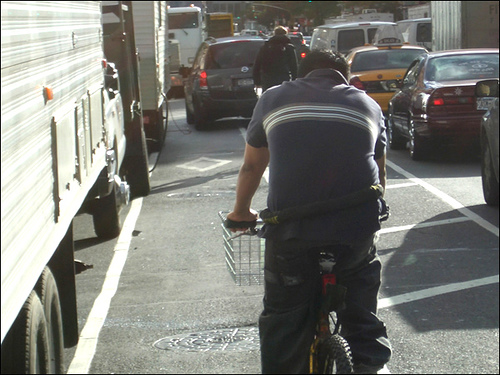
Nothing is more exhilarating, efficient and enjoyable than getting on a bicycle zipping through the crowded streets of New York City, provided the rider does not mind assuming the role of transit pioneer and cycling soldier… there is a daily battle taking place on the streets of New York City between automobiles and bicycles.Via Streetsblog.
Photo: Cody Lyon, Ohmy News International
I've been feeling like I've been more and more at war with the car drivers of this city, especially over the last week. Dangerous passing, inattentiveness and general being selfish slaves to their cars have "put my back up" lately.
After checking out the newmindspace event on my way to work this morning, I paced another cyclist up University from King to College and effectively took the lane with his help, screwing any drivers behind us.
It felt good.
2 comment(s) on this post
links to this post
-
Vic said...
-
I've noticed that drivers got crankier and more aggressive after about mid-September.
Last night on my way home I had someone in an SUV honk at me, then pass aggressively, only to turn infront of me into a parking lot on the right just just a few metres later. I must have slowed him/her down by a whole 5 seconds or so.
Still, the biggest traffic slowdowns on my commute are caused by motorists turning left and blocking the "fast" lane, or lining up to get on the 427. Or even worse, parallell parking on a street like Bloor downtown. Most sinful is when they block crosswalks. Therefore I don't feel so bad when I slow someone down for a couple of seconds while they wait to pass.
Cars are always getting in the way of traffic. I'm glad I ride a bike. :) -
Darren J said...
-
I've had some good and bad this month. The problem is that when it's bad, it makes this whole endeavor so difficult. This morning 3 people passed me way too close and I wanted to give up by the time I got to work. I would really miss those good rides though.
Links to this post:
 As promised, here's all 8 Secrets in one post (I have them linked individually down at the bottom, if that's what floats your boat...). This is the easiest way to print out all of them into a poster you can hang in your bedroom, cubicle and on your grocery store bulletin board. Haha.
One secret I didn't include is the most important one:
While these 8 things will help you deal with car traffic in a city, you'll learn them with experience, so the most important thing you can do to make yourself comfortable on the roads is to bike a lot. You'll become more and more comfortable the more experience you have out there.
 For instance, I have a 7 km route to work, and I know through lots of repetition of this route where cars tend to slow down and speed up... where I have to be extra-vigilent and careful due to drivers thinking they can pass me safely when they can't. This isn't learned through 8 tips on a website, but with experience.
 These tips though, these tips will help you become more comfortable faster, as you have now essentially pulled out all the information I've learned over the past 2 years biking Toronto.
~ ~ ~ ~ ~
These are geared towards downtown cycling, since that's what I'm most familiar with.
These all assume that you already know about proper lighting and safety (ie. helmets) precautions, and know that riding on sidewalks is one of the most unsafe things you can do, for both pedestrians and yourself.
~ ~ ~ ~ ~
1. Drivers Don't Want to Kill You
 It's hard to believe sometimes, because drivers can often do some pretty thoughtless things out there, and despite all the evidence to the contrary, it's true.
 They may not like you... they may think you are in their way, that you are too slow, that you don't belong on the road, and that your tight cycling butt looks way better than their flabby one stuck in their car, but most of them are not homicidal.
This is mainly because they are seeing things from a drivers' perspective, and often have not given much thought to how vulnerable cyclists are. The vast majority of drivers don't want to kill you... they just don't understand you.
I bet any cyclist you know with a drivers license can tell you that knowing things from a cyclists' perspective has made them a much better driver.
Knowing this one thing will give you a lot of confidence.
2. Ride In A Straight Line
 Don't ride in the gutters and then swing out into the road to avoid the drains. This throws drivers off-guard because they aren't thinking about the drains and aren't expecting you to do this. There's a very good chance you'll get honked at if you do this, because nothing scares a driver more than a cyclist swerving in front of their car.
 Instead, imagine that the entire length of the road is lined with gutters. Ride at least that far away from the curb. It's hard at first, because you may be afraid of those cars driving beside you, but most drivers will pass you at a safe distance the further you ride out from the curb.
3. Play By The Rules
 You and your bike constitute "a vehicle" according to the Highway Traffic Act. This means that you have to abide to the same rules that drivers do. This means stopping at red lights, stopping for people at crosswalks, and not passing open streetcar doors.
 This is really important because if drivers see you respecting the laws, they are more likely to respect you. On the other hand, if they're stopped at a red light and you blow right through it because (hopefully) the way is clear, they are going to be mad at you.
Why should they treat you like a vehicle with a right to the road if you don't behave like one?
4. Avoid The "Stoplight Squeeze"
 The next time you get to a red light before cars do, DON'T put your right foot down on the curb. I know it's tempting as it's a handy little footrest, but if you're right beside the curb, any drivers that come up behind you will drive up beside you (often too close) and you'll be "squeezed" when the light turns green, having to wait for that car to go before you can.
 Instead, when you get to the red before cars, swing out a little to the left (I usually stop about 1/3 of the way between the curb and the next lane), and lean over to the left, putting your left foot down. This forces drivers to stop behind you, and gives you "first dibs" when the light turns green.
5. Signal Sensibly
 Drivers are trained to look for signals. Stoplights, stop signs, turn signals, brake lights... all of these things catch the attention of a driver. It's what they look for to make sure they don't hit anyone. Letting them know that you're planning on turning, or coming out into the road more to pass a parked car is just courteous (see #3 above).
 Biking hand-signals are traditionally confusing... pointing up means turning right? Pointing left means you're going straight? That's confusing - especially for drivers who don't know about cycling.
Apparently, it's now acceptable to point in the direction you're going (it makes sense), so point where you're going. It keeps everyone on the same page. Do it well ahead of any turns, so that drivers know that you're planning to turn, and they can act accordingly to avoid you.
6. Take That Lane
 This is just what it sounds like. Taking your place in the middle of a lane because it's unsafe at the edge of it.
 This is mostly done on streets where the curb lane is filled with parked cars. You can't ride in the curb lane right beside the cars because of the possibility of getting "doored" (also called "winning the door-prize") by someone getting out of their car.
Therefore, you ride in the other lane. Most of the time (especially downtown), you'll be moving at the same speed (or faster) than vehicular traffic, so you'll fit right in to traffic.
If you're moving slower than traffic, remember that you're a vehicle and have a right to be there if you're abiding by the laws, and move out of the lane whenever you get a chance.
7. Make Them Think You're Unpredictable
 This is something that I've learned only recently. If I'm in a stretch of road where drivers are passing too closely or I just want more room, I look over to my left or over my left shoulder. Sometimes I'll be looking at a store, or someone on the sidewalk, or down a street, but most of the time I'm just looking left for the sake of looking left.
 I've found that the simple act of looking over to the left is enough sometimes to give me more road space. Drivers, if they see you do this, seem to think that you're thinking of moving to the left (even if you aren't) and are checking to see if it's clear.
If they think you may be coming left, they'll give you more room. They don't know you're responsible and predictable and would signal before doing anything.
8. Ride With Others
 I don't get a chance to do this often (especially lately because it's been winter) but the biggest factor when riding with cars is having a presence. It's easiest to do this if there is more than just you biking.
 Cars are more likely to see 2 bikes than one, 4 bikes than 2, 10 bikes than 4, and so on. The more bikes, the more chances that one of the people riding them will do something unpredictable, so drivers give groups of bikes (even those riding single-file) much more space than single riders.
You don't have to know everyone you're riding with either... when the weather is warm, there are lots of bikes out on the street, and often you'll find yourself riding with other people out there on the road. Notice that you'll hardly ever have a close call with a car passing you too closely if there's atleast 2 of you riding along. Not to say it never happens... it just seems to happen less.
 The main thing to do is get out on your bike as much as you can... the more people see you out there having a good time, going faster than traffic in a fun, cheap, and pollution-free way, the more likely they are to try it too. The numbers of cyclists on the road has the potential to grow exponentially this way.... the more cyclists people see out there, the more people are curious to try it. Imagine if you saw groups of cyclists riding by you all day every day... you'd want to know what all the fuss was about!
This is also the concept behind Critical Mass and the Ride Matching (or BikePooling) section of the Cycling Cog... it's easy for a driver in a car to bully one cyclist off the road, but stick a few (or more) cyclists on the road, and they take on the presence of a car... perhaps more than one car. There is strength in numbers.
Note: Thanks to everyone who has left comments in this series of posts, and to everyone who has linked to them. I'm happy that you are finding them useful. I'll be putting all of them into one post sometime tomorrow for easy reference, feel free to tell anyone you know who is new to biking (or is thinking of taking it up) about them.
Individual Secrets:
1. Drivers Don't Want to Kill You
2. Ride In A Straight Line
3. Play By The Rules
4. Avoid The "Stoplight Squeeze"
5. Signal Sensibly
6. Take That Lane
7. Make Them Think You're Unpredictable
8. Ride With Others
10 comment(s) on this post
links to this post
-
said...
-
Your rule number 7 clashes with the teaching of CanBike, where it teaches we are traffic. And if we purport to be traffic we need to act as traffic rule numbers 3&5 help. If you are leaving the impression that you are going to shift left, do you not think that the caged driver behind you in a hurry will not try to get that split second edge and jump right. Right into a "fake" move left. As a school bus driver and cycling instructor, I know that being predictable is what keeps me out of incidents.
B -
joe said...
-
I'm NOT advocating being unpredictable. You should always signal when you want to change direction, and do so when it is safe.
What #7 says is if cars are passing you too close, simply LOOK to the left (as if checking traffic - which you should be doing anyways)... most drivers will take this as a sign you are thinking of moving left, and will give you more room when passing.
Thanks for the input, though.
-----
I have a feeling people are skimming these points... yet another good reason for splitting these tips into individual posts like I did earlier... information is easily digested in small chunks. :) -
Tanya said...
-
Heh it seems like #2 and #7 could be contradictory. I get the idea of #2 you don't want to weave in and out of things, but I do like to move from side to side a little bit rather than being dead on straight - I find this makes drivers leave more room when passing, when they think you are a bit on the unpredictable side.
-
SueJ said...
-
I'm thinking secret number one should be included in the eight. I know it really helps me to know how long the walk lights take to cycle through at the assorted intersections along my commute, and how the light cycle one block down affects oncoming traffic at my busiest unlighted intersection, and of course the places where people are most likely to be turning at what time.
I agree with that "appearing unpredictable" tactic on the grounds that your goal is to effectively communicate: "I need this space." If drivers aren't getting that message when you're streamlinedly hugging your spot in the lane, then a different line of communication just makes sense. I'll have to try to remember to experiment with looking... I've got a nice mirror so I seldom do. -
Kiril, The Cycling Dude said...
-
Yes!
Now I can spread the word to MY readers about this wonderful series! ;-D -
said...
-
I would disagree with #1. It has been my experience that there are quite a few drivers that actually do want to kill cyclists or would not care if they did and would believe it was the cyclist's fault.
I consider every car as one that is about to try to take me out. People have massive road rage. Drivers act like complete assholes. You need to be prepared to be extremely defensive. The people in the cars are trying to get you. -
joe said...
-
Healthy debate is always good. Thanks for the opinion, Anonymous.
-
kimbofo said...
-
Wow. I love this post. I agree with everything you say - I have been commuting through traffic here in London, UK, for about 7 months now, and have come to learn your tips through hard experience (and a few near misses). I think the most important thing I have learnt is not to be afraid to 'take' the lane. This is something that is clearly spelled out in John Franklin's excellent book 'Cyclecraft'
-
ashley said...
-
My tire got caught in a streetcar track yesterday at the intersection of Dundas and Spadina. I was flung into traffic and was almost smushed by a few cars. Luckily I was able to get up quick enough...however, no one offered any help or asked if I was okay, which I found weird.
Anyway, any advice or general safety tips when it comes to streetcar tracks? -
joe said...
-
Great question ashley... and I've been meaning to update this series with some more tips - and a streetcar track tip is a great idea. :)
Streetcar tracks are tricky. Real tricky. My best advice is to hit them (when possible) at close to 90 degree angles (like when you're hopping curbs) to minimize that change of getting your tire caught in one.
Be especially wary in cold or wet weather, as the steel tracks become very slippy.
I always tend to slow down and try to "jump" my front tire over them when I can to minimize the chances of getting caught.
Thanks for commenting!



I feel like if I get hit, it's going to be so major that it's not going to matter whether I'm wearing a helmet or not.
Joe - this is great stuff! I only wonder why we don't have this on I Bike TO?? (perhaps it is in th emoderation queue and I don't know!) I didn't know you stopped wearing the skid lid! I hope you will crosspost this to I Bike TO. It's great research and also a good personal story! thx tammy
Yeah, I just didn't get a chance to post it on Friday before I left for the weekend. :)
Are there any statistics comparing the success of helmets in these traumatic head injury situations?
http://www.helmets.org/stats.htm
While you can find more recent info online, I just wanted to find something that illustrated what I was about to mention; that your statistics do not support your claim - they support the claim that of the head injuries seen in hospitals, only a minority relate to bike injuries (which is to be expected, until we have 20 million daily bike commuters).
Of bike related injuries, and ONLY bike related injuries, how many head traumas involve helmets vs no-helmets - this is what you should ask. And the answer from that link (though a bit out of date), is that as expected. non-helmeted riders account for 90% or more of reported head trauma hospitalizations.
Your analogy to cars is also poor. The direct comparison would be helmets to seatbelts, which are the critical component to preventing head injuries. Hitting the windshield and flying through it are not preventable by a helmet in that situation, without a seatbelt.
Would you suggest people stop wearing seatbelts in cars because only a maximum of 12000 drivers out of over 18,000,000 (that's 0.067 %) in Canada suffered traumatic head injuries (we're assuming all injured were wearing seatbelts)? Why at 2.5% for cyclists, that makes cyclist 36 times more likely to be involved in head traumas than auto drivers.
So you're statement that it's much more likely to be hurt while in a car.....uh, no, sorry. Go fish.
Of course, your original argument is flawed to begin with, since the stats do not support the claims, but it shows what happens when you make incorrect claims about stats.
Whether you dislike wearing a helmet or not, your opinion on their safety is completely uninformed and at worst, purposely misleading. They do provide increased protection, as do seatbelts in motor vehicles, and they do reduce the number and seriousness of head traumas reported. You can choose not to wear one, but the increased risk if you're involved in a collision/fall is something you take on, whether you like it or not.
As more people do wear helmets, the number of injuries for helmeted people relative to non-helmeted will rise of course, as it should. That does not mean that helmets are becoming more unsafe. Nor does it mean they don't reduce or mitigate the risk of serious injury in accidents. The anti-seat belt lobby tried to take this tack a few decades ago, and it failed because the seriousness of injuries for seatbelt wearing patrons did and does remain low in comparison to non-seatbelted patrons. With bikes, expect to see fewer deaths, fewer major head traumas (like a cracked skull), and a co-commitant rise in minor head trauma or minor injuries. After all, people are still going to get hit or fall, they just won't be as likely to die or require hospitalization when wearing a helmet.
By the way, promoting helmet use does not mean you should not wear ADDITIONAL protection on bikes, in cars, or in any endeavour. Full face bike helmets should be mandatory (much as on motorbikes), as should knee, arm, and wrist pads. Ask anyone in the Lacrosse or Inline skating community (yes, I'm in both) about the efficacy of body armour and helmets, esp full face helmets. Or just ask anyone who's had their teeth knocked out or jaw broken.
Wearing a proper helmet is not the total safety end-all. But it's the right start....
Thanks for your input Tony.
Post a Comment
<< Home